Risk assessment: NV-2 water level probe, version 1.0
Fictional example, written for the "CRA & Dev" series to illustrate Article 13 of the Cyber Resilience Act. The product, the choices and the ratings are examples: they do not replace the analysis of your own product.
PDF version: evaluation-risques-sonde-niveau-eau.pdf. Source: examples/07-risk-assessment/en/water-level-sensor.md.
1. Context
| Item | Content |
|---|---|
| Intended purpose | Measure the water level of a public tank or reservoir, derive the volume, send it every hour over LoRaWAN, and raise an alert at once below a low threshold or above a high one. The local authority uses it to plan refills and to monitor its firefighting water reserves. |
| Reasonably foreseeable use | Sole monitoring of a firefighting reserve, without regular visual checks; leak detection; data shared with the emergency services. |
| Conditions of use | Outdoors, on remote and often unattended sites. Battery powered. Public LoRaWAN network. |
| Assets to protect | Integrity and availability of the levels and alerts, on which the safety of people depends for firefighting reserves; alert thresholds; firmware integrity; LoRaWAN keys (a root key unique to each device). |
| Data processed | Level, computed volume, temperature, battery voltage, lid state. No personal data. |
| Expected time in use | 10 years. Support period: 10 years. |
| Interfaces | LoRaWAN radio (readings, alerts, threshold configuration, updates); SWD debug port, locked in production; lid switch. |
2. Diagram
The numbers refer to the risks in the next table.
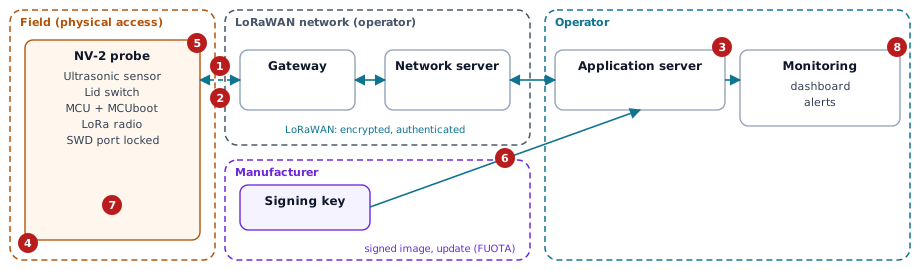
3. Risks
Likelihood (L) and impact (I): low, medium, high.
| # | Threat: who, through what | L | I | Decision | Measure or justification |
|---|---|---|---|---|---|
| 1 | A forged or replayed frame makes an empty reserve look full | low | high | reduce | Authenticated frames and frame counters; OTAA activation only: each session has its own keys, a frame from a past session is rejected; the platform rejects physically impossible level changes (point 2 (f)). |
| 2 | The probe goes silent (jamming, flat battery, destroyed probe) and a drop goes unnoticed | medium | high | reduce | A heartbeat every hour; a low-battery alert a month ahead. Assumption documented in the user guide: the platform must alert after two missed messages (point 2 (h)). |
| 3 | Alert thresholds are changed remotely to silence the alerts | low | high | reduce | Configuration accepted only if authenticated; bounded thresholds; each change is reported to the platform and logged (point 2 (d), (l)). |
| 4 | On site, someone opens the probe, moves it or blocks the sensor | medium | medium | reduce | The lid switch sends an alert; a reading outside the possible range is flagged (point 2 (d)). |
| 5 | The root key is extracted from a stolen probe | medium | low | reduce | One key per device: a theft compromises one probe only. SWD port locked (point 2 (d), (j)). |
| 6 | Malicious firmware is pushed through the radio update | low | high | reduce | Image signed by the manufacturer, verified by MCUboot before installation; rollback to an older version forbidden (point 2 (c), (f)). |
| 7 | A known vulnerability affects a dependency (RTOS, LoRaWAN stack) | high | high | reduce | SBOM for each release, continuous monitoring; fix released without delay, separate from functional changes (Part II, points 1 and 2). |
| 8 | The local authority's server is compromised and shows false values | medium | high | out of scope, documented | Outside the product. The user guide recommends two-factor authenticated access and alerts sent through a second channel. |
4. Annex I, Part I, point 2
| Point | Applicable? | Implementation, or justification |
|---|---|---|
| (a) No known exploitable vulnerability | Yes | SBOM analysed before each release; no known exploitable vulnerability is shipped. |
| (b) Secure by default, reset to original state | Yes | No shared default secret; cautious factory thresholds. An internal button restores the factory configuration, and the probe reports it. |
| (c) Security updates | Yes | Signed radio updates, installed automatically by default; the operator can postpone them. |
| (d) Protection from unauthorised access | Yes | No local interface; SWD locked; only authenticated commands are accepted; lid opening reported. |
| (e) Confidentiality | Yes, low stakes | Payload encrypted by LoRaWAN; no personal data. |
| (f) Integrity | Yes, high stakes | Authenticated frames, frame counters, OTAA activation; signed firmware; bounded thresholds. |
| (g) Data minimisation | Yes | Only the quantities needed for monitoring are sent. |
| (h) Availability of essential functions | Yes, high stakes | Thresholds are evaluated in the probe, without waiting for a command; hourly heartbeat; watchdog; low-battery alert. |
| (i) No impact on other networks | Yes | Radio duty cycle respected; connection retries spaced out, with some randomness. |
| (j) Limited attack surface | Yes | A single external interface, the radio; SWD locked. |
| (k) Exploitation mitigation | Yes | Compiler and RTOS hardening (stack canaries, MPU memory protection). |
| (l) Logging and monitoring | Yes | Threshold changes, lid openings, restarts and updates are sent to the platform. The opt-out exists, as the text requires; it is itself reported, and the user guide advises against it for a firefighting reserve. |
| (m) Removal of data and settings | Yes | Factory reset erases the session, thresholds, configuration and local history. The root key is kept: it is the device's identity, not user data. |
5. Annex I, Part I, point 1, and Part II
- Target cybersecurity level: high. An empty firefighting reserve that looks full puts the safety of people at stake, which Article 13(2) requires to be taken into account. Integrity and availability of the alerts come first.
- Vulnerability handling: a CycloneDX SBOM for each release, continuous monitoring of dependencies, a published contact address with a disclosure policy, fixes delivered without delay by radio update, published security advisories.
6. History
| Date | Version | Change |
|---|---|---|
| 2026-10-06 | 1.0 | First assessment. |